The Best Exercise For Overall Health
November 4, 2025
Why One Pound Matters More the Leaner You Get
January 10, 2026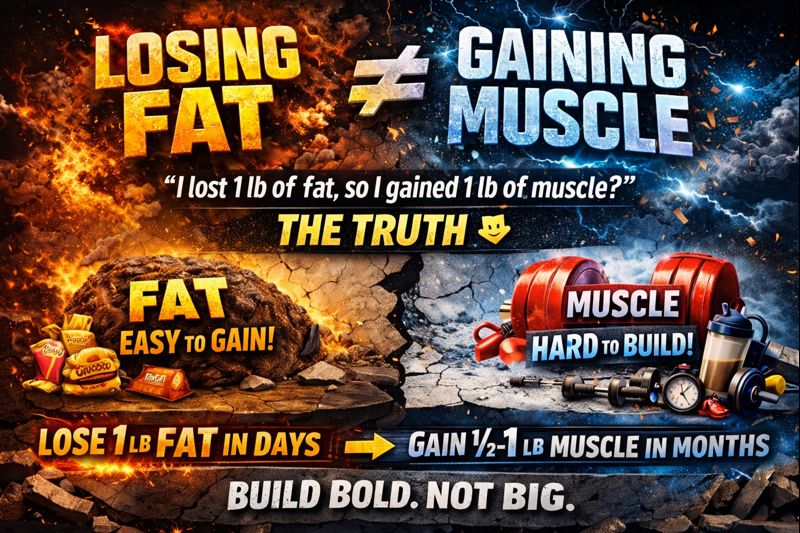
Losing Fat Is Not the Same as Gaining Muscle
Why the Scale Lies — and How the Body Actually Changes
One of the most common misunderstandings in fitness is the belief that fat loss and muscle gain are two sides of the same coin. They are not.
Many people assume that if they lose one pound of fat, that pound is automatically replaced with muscle. This belief sounds logical, but it ignores how the human body actually adapts to stress, energy intake, and recovery.
Understanding the difference between fat loss and muscle growth is essential if your goal is to become leaner, stronger, and more capable — not just lighter.
Fat and Muscle Are Built on Different Biological Systems
Fat and muscle behave differently because they serve completely different purposes in the body.
Fat is stored energy.
It exists to protect you from starvation and fuel future activity. When calories exceed demand, the body stores fat efficiently and quickly.
Muscle is functional tissue.
It is expensive for the body to maintain. Muscle only grows when there is a clear survival or performance reason to do so — typically resistance training combined with adequate nutrition and recovery.
This is why fat accumulation happens faster than muscle development.
Why It’s Easier to Gain Fat Than Muscle
Your body is highly optimized to store fat. Evolution designed it that way.
• Fat requires minimal biological effort to store
• Excess calories can convert to fat in days
• Hormones favor fat storage under stress, poor sleep, or inactivity
Muscle, on the other hand, is conservative.
• Muscle requires progressive overload
• Protein synthesis must exceed breakdown
• Recovery and sleep are mandatory
• Progress happens slowly, even when done correctly
This is why you can gain fat in a weekend — but gaining quality muscle takes weeks or months.
What Actually Happens When You Lose Weight
When the scale goes down, several things may be happening at once:
• Fat loss
• Water loss
• Glycogen depletion
• Muscle loss (if training or protein intake is insufficient)
The scale does not distinguish between these variables. It only reports total mass.
This is why aggressive dieting without resistance training often results in a smaller body that looks softer rather than leaner.
Muscle Growth Is Slow — Even Under Ideal Conditions
Even with disciplined training and nutrition, muscle growth is modest.
For most adults:
• 0.5 to 1 pound of muscle per month is excellent progress
• Growth slows further with age and training experience
This is not failure. This is biology.
Muscle is built through repeated signals over time, not single workouts or short-term diets.
Fat Loss Can Happen Quickly — But at a Cost
Fat loss occurs when energy demand exceeds intake. This can happen rapidly.
However, when fat loss is rushed:
• Hormones adapt
• Strength drops
• Muscle is often lost alongside fat
The goal is not maximum speed — it’s maximum quality.
Preserving muscle while losing fat is what creates a strong, defined, capable body.
The Real Goal: Body Recomposition
The ideal outcome is not simply losing weight.
It’s replacing fat mass with functional muscle over time.
This requires:
• Consistent resistance training
• Sufficient protein intake
• Moderate, sustainable calorie deficits
• Patience
Recomposition is slow — but the results last.
Why the Scale Is the Wrong Primary Metric
If fat comes off faster than muscle goes on, the scale will always mislead you.
Better indicators of progress:
• Strength levels
• Measurements
• How clothes fit
• Visual changes
• Energy and recovery
The scale is a data point — not a verdict.
Final Thought: Build for Capability, Not Just Weight Loss
Fat comes and goes easily.
Muscle is earned.
The body you want is built through repetition, discipline, and long-term thinking — not quick trades between pounds.
Build bold. Not big.
Focus on strength, structure, and consistency — and let the body adapt.